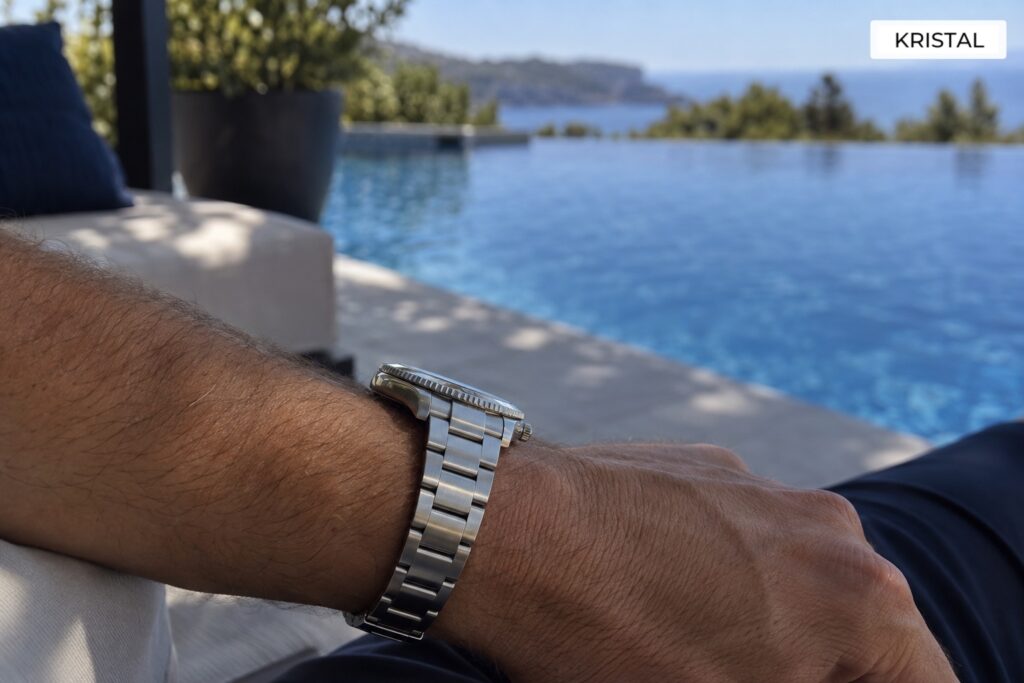

To read a Rolex GMT-Master II, use the ordinary hour and minute hands for local time. Read the extra triangle-tipped hand against the bezel’s 24-hour scale for your chosen reference time, such as home time in Malaysia. For this home-time reading, the bezel must be neutral, with its triangle aligned with the dial’s 12 o’clock marker.
Check the scale before reading the extra hand. It can show you whether someone back home is likely to be awake before you call.
Know which part you are reading
Rolex’s GMT-Master II feature guide identifies the additional triangle-tipped hand and the graduated rotating bezel as the second-time-zone display. Keep the two hour scales separate:
| Part | What to read | Common confusion |
|---|---|---|
| Ordinary hour hand | Local hour on the 12-hour dial | The dial alone does not distinguish morning from evening. |
| Triangle-tipped 24-hour hand | Reference hour against the neutral bezel’s 24-hour scale | Reading it against the ordinary dial gives the wrong hour. |
| Minute hand | Minutes on the ordinary dial | The extra hand does not replace the minute hand. |
| Date window | The date linked to local time | It need not match the calendar date back home. |
The examples below assume a running, correctly set watch.
Try a simple home-and-away example

Imagine that you have chosen Malaysia as your reference time. It is 2:20 pm at home, while your hypothetical destination is one hour ahead, at 3:20 pm. The destination is hypothetical; check the actual offset for any trip.
You would read the local hour as three, with twenty minutes on the minute scale. For home time, you would read the extra hand against the bezel slightly past 14, since twenty minutes have already elapsed. The shared minute reading gives you 14:20, or 2:20 pm.
Do not expect the extra hand to point towards two on the ordinary dial simply because it is two in the afternoon at home. The two hour hands complete their circuits over different periods. Their positions can look quite different even when they show the same time.
For a quick personal check, say the readings in full: “Local time is 3:20 pm; home time is 14:20.” Saying the time aloud helps catch a mistaken reading.
Crossing midnight can produce different dates

Consider another hypothetical moment: it is 00:30 on Tuesday at home in Malaysia, but your destination is one hour behind, at 23:30 on Monday. Both readings can be correct at the same instant.
The date window follows local time. In this example it would still correspond to Monday’s calendar date, even though Tuesday has begun at home. A difference between the local date and your home calendar does not, by itself, show a fault.
Before arranging a call, include the day as well as the hour. Read the reference hour, then consider whether home has already crossed midnight. The watch does not provide a separate home-date window for you to consult.
Check the bezel before deciding something is wrong
Check that the bezel triangle is still aligned with 12 o’clock. If someone has rotated the bezel, the number beneath the extra hand can represent a different time zone.
Rolex’s official GMT-Master II user guide explains both the neutral reference display and the alternative reading produced by turning the bezel. It also confirms that the date is linked to local time.
Before comparing the watch with another clock, establish what reference was chosen and whether the bezel is neutral. Otherwise, you may be comparing two different places without realising it. A borrowed or recently purchased pre-owned watch may still reflect the previous wearer’s choices.
Your reference does not have to be Greenwich time
You can choose home time as your reference; the GMT name does not require a Greenwich-time setting. For a Malaysian traveller, keeping Malaysia as the reference can make the display easier to use.
Make that choice explicit when someone demonstrates the watch. “Which time zone is this hand showing?” is more useful than assuming every GMT-Master II has been set the same way.
Separate reading from setting
This guide explains the display. For adjustments, use instructions appropriate to your exact reference or ask a knowledgeable watch professional to demonstrate them. Do not apply GMT-Master II instructions automatically to an original GMT-Master or another Rolex model.
The worked examples use whole-hour differences. They should not be treated as instructions for destinations with half-hour or quarter-hour offsets. Check the actual time difference for your travel dates before relying on a setup.
If the watch has stopped, start with our guide to why a Rolex stops when it is not worn for the next steps.
Common questions
Should both hour hands point in the same direction at home?
Not necessarily. They use different hour scales. Compare the times you read from those scales, rather than expecting the hands to overlap.
Does a working GMT display prove authenticity?
No. Reading or operating a function is not an authentication result. It also tells you nothing conclusive about a pre-owned watch’s service condition or resale value.
If you are considering selling your Rolex
If ownership plans change, our Rolex selling guide for Malaysia explains the available selling routes. You can contact Kristal for an initial Rolex resale enquiry; any assessment or offer depends on review of the specific watch.